Rear Brakes
- If installed, remove the rubber dust caps from both bleeder screws on each caliper.
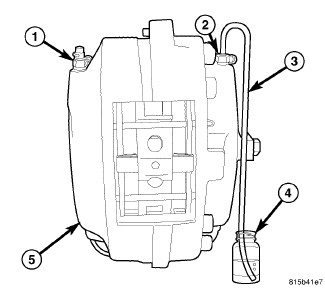
- Start at the first wheel circuit that needs to be bled (See list in above note). Attach a clear hose (3) to the inboard bleeder screw (2) at the wheels brake caliper and feed the other end of hose into a clear jar (4) containing enough fresh brake fluid to submerge the end of the hose.CAUTION:
Open the bleeder screw at least one full turn when instructed. Some air may be trapped in the brake lines or valves far upstream, as far as ten feet or more from the bleeder screw. If the bleeder screw is not opened sufficiently, fluid flow is restricted causing a slow, weak fluid discharge. This will NOT get all the air out. Therefore, it is essential to open the bleeder screw at least one full turn to allow a fast, large volume discharge of brake fluid.
- Open the inboard bleeder screw (2) one full turn to obtain an adequate flow of brake fluid.
- After bleeding 118-237 ml. (4-8 oz.) of brake fluid through the brake hydraulic circuit, and maintaining an air-free flow (no bubbles) is in the clear plastic hose (3) and jar (4), close the bleeder screw (2).
- Remove the clear hose and install the bleeder screw dust cap.
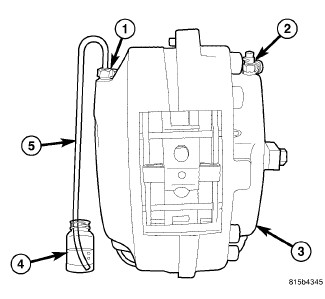
- Attach a clear hose (5) to the outboard bleeder screw (1) at the same brake caliper and feed the other end of hose into a clear jar (4) containing enough fresh brake fluid to submerge the end of the hose.CAUTION:
Open the bleeder screw at least one full turn when instructed. Some air may be trapped in the brake lines or valves far upstream, as far as ten feet or more from the bleeder screw. If the bleeder screw is not opened sufficiently, fluid flow is restricted causing a slow, weak fluid discharge. This will NOT get all the air out. Therefore, it is essential to open the bleeder screw at least one full turn to allow a fast, large volume discharge of brake fluid.
- Open the outboard bleeder screw (1) one full turn to obtain an adequate flow of brake fluid.
- After bleeding 118-237 ml. (4-8 oz.) of brake fluid through the brake hydraulic circuit, and maintaining an air-free flow (no bubbles) is in the clear plastic hose (5) and jar (4), close the bleeder screw (1).
- Remove the clear hose and install the bleeder screw dust cap.
- Bleed the opposite rear brake wheel circuits as necessary in the same manner until all air is removed from the brake hydraulic system, then proceed to the front brakes.