Unit, Front Lamp: Installation: Lamp
To avoid serious or fatal injury when working on the High Intensity Discharge (HID) headlamp system, be certain to take the proper precautions. The headlamp switch must be in the OFF position. Disconnect and isolate the battery negative cable. There is a risk of fatal injury caused by contact with high voltage used in the HID headlamps. There is a risk of explosion or fire caused by highly flammable materials in the vicinity of damaged HID lighting elements. There is a risk of injury caused by exposure to Ultra Violet (UV) light, a risk of burns caused by high component operating temperatures, a risk of mercury poisoning through glass splinters produced by bursting HID lighting elements. There is also a risk of poisoning caused by inhalation of mercury vapors and by toxic salts and mercury compounds being ingested or coming into contact with the skin. Do not come into contact with parts that are under high voltage. Persons with active electronic implants (e.g. heart pacemakers) must never work on HID headlamps. Wear insulated safety shoes, safety glasses and protective gloves. Remove flammable materials and ensure sufficient ventilation in the working area.
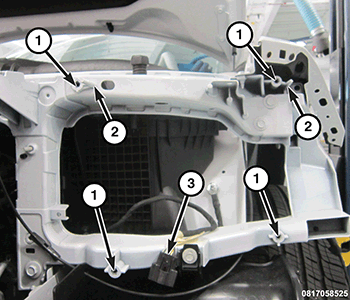
- Position the front lamp unit (1) close enough to the front of the vehicle to reconnect the wire harness connection (3) to the back of the lamp housing. Line the housing up with the alignment guide pins (2) and the screw mounts (1). Seat the headlamp assembly to the vehicle once properly aligned.
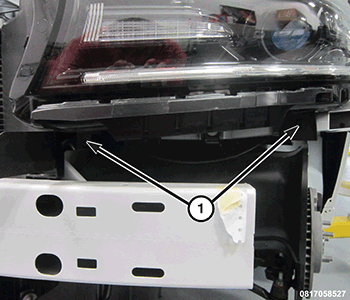
- Install and tighten two screws (1) that secure the lower mounting bracket of the headlamp to the body.
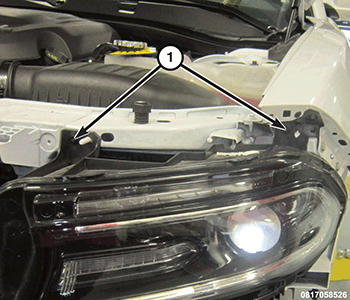
- Install and tighten the two screws (1) that secure the upper mounting bracket of the headlamp assembly to the body.
- Install the fascia onto the vehicle. Refer to FASCIA, FRONT, INSTALLATION .
- Connect the battery negative cable.
- Confirm proper headlamp alignment. Refer to STANDARD PROCEDURE .