Master Cylinder, Brake: Installation
CAUTION:
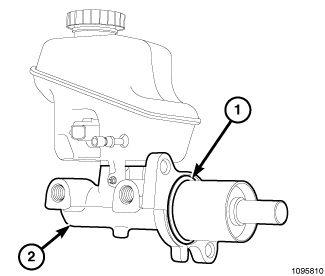
When replacing master cylinder on vehicle, a NEW vacuum seal (1) MUST be installed on master cylinder.
- Thoroughly bleed master cylinder before installing it on vehicle. Refer to MASTER CYLINDER, BRAKE, STANDARD PROCEDURE .
- Install a NEW
vacuum seal (1) on rear of master cylinder (2) making sure seal fits squarely in mounting groove.
- Position master cylinder on studs of power brake booster, aligning booster push rod with master cylinder piston.
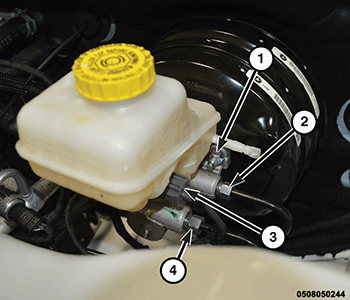
- Install two NEW Master Cylinder to Brake Booster Nuts (1). Tighten to the proper torque specifications. Refer to TORQUE SPECIFICATIONS .
- Thread primary (2) and secondary (4) brake tubes into master cylinder primary and secondary ports. Tighten Brake Tube Nuts to the proper torque specifications. Refer to TORQUE SPECIFICATIONS .
- Connect the brake fluid level sensor wiring harness connector (4).
- Connect the negative battery cable. If equipped with an Intelligent Battery Sensor (IBS), connect the IBS connector.WARNING:
Be certain a firm brake pedal is achieved prior to attempting vehicle operation. If a firm brake pedal cannot be achieved, bleed entire brake hydraulic system and check for leaks.
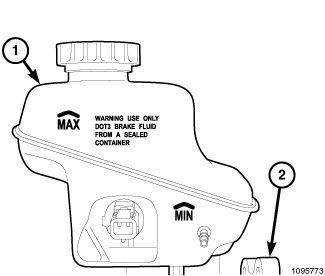
- Fill master cylinder fluid reservoir (1) with clean, fresh Mopar® Brake Fluid or equivalent.
- Start engine and let idle for approximately 30 seconds, then turn off and wait about 1 minute. Fully stroke brake pedal to assure there are several strokes with assist prior to depletion of vacuum. If not, check for missing seal between master cylinder and booster.
- Install access panel in cowl area.
- Road test vehicle to ensure proper operation of brakes.